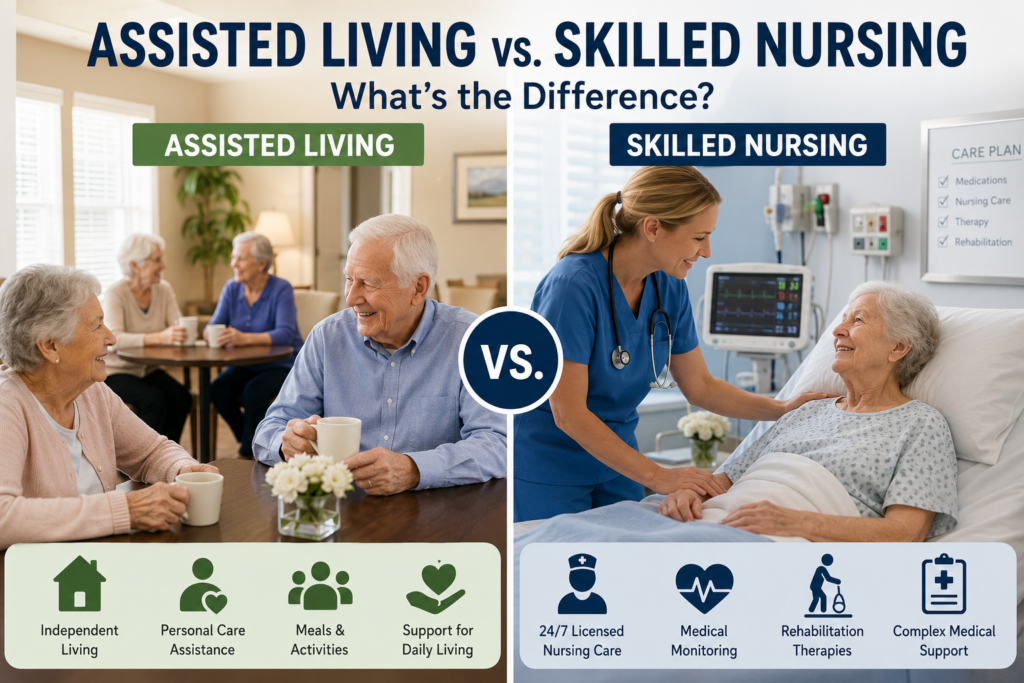
Introduction
Assisted living vs skilled nursing is one of the most common comparisons families make when deciding on the right level of care for an aging loved one.
Although these terms are sometimes used interchangeably, they provide very different levels of care. Choosing the wrong option can affect your loved one’s health, quality of life, independence, and finances.
Understanding how assisted living differs from skilled nursing care can help families make informed decisions during what is often a stressful and emotional time.
In this guide, you’ll learn:
- The primary differences between assisted living and skilled nursing
- Who each option is designed for
- What services are typically provided
- Typical costs and payment options
- Questions to ask before choosing a community
At a Glance
| Category | Information |
|---|---|
| Best For | Families comparing long-term senior care options |
| Estimated Reading Time | 11 minutes |
| Last Updated | July 2026 |
| Who Should Read This | Seniors, adult children, caregivers, and family decision-makers |
| What You’ll Learn | Care levels, costs, services, eligibility, and how to choose the right option |
Assisted Living vs. Skilled Nursing: What’s the Difference?
The biggest difference is the level of medical care provided.
Assisted living is designed for older adults who remain relatively independent but need help with certain daily activities such as bathing, dressing, medication reminders, or meal preparation.
Skilled nursing facilities (often called nursing homes) provide 24-hour licensed nursing care, rehabilitation services, and ongoing medical supervision for individuals with more complex health needs.
While both provide housing, meals, and personal assistance, the amount of healthcare available differs significantly.
Comparison at a Glance
| Feature | Assisted Living | Skilled Nursing |
|---|---|---|
| Housing | Private or semi-private apartments | Private or shared rooms |
| Meals | ✔ | ✔ |
| Housekeeping | ✔ | ✔ |
| Medication Assistance | ✔ | ✔ |
| Help with Daily Activities | ✔ | ✔ |
| 24-Hour Nursing Care | Limited or not available | ✔ |
| Physical Therapy | Limited | ✔ |
| Occupational Therapy | Limited | ✔ |
| Speech Therapy | Limited | ✔ |
| Physician Oversight | Periodic | Ongoing |
| Medical Monitoring | Limited | Continuous |
What Is Assisted Living?
Assisted living communities are designed for seniors who want to maintain as much independence as possible while receiving assistance with everyday tasks.
Residents typically live in their own apartment or suite and participate in community activities while receiving help as needed.
This assisted living vs skilled nursing comparison highlights the most important differences families should consider.
Common services include:
- Assistance with bathing and dressing
- Medication reminders or management
- Three daily meals
- Housekeeping
- Laundry services
- Transportation
- Social and recreational activities
- Emergency response systems
Many assisted living communities encourage residents to remain active and independent while providing support only where needed.
What Is Skilled Nursing?
A skilled nursing facility provides the highest level of care available outside of a hospital.
Residents often require ongoing medical attention due to:
- Recovery after surgery
- Stroke rehabilitation
- Serious illness
- Complex medication management
- Chronic medical conditions
- Limited mobility
- Advanced physical care needs
Licensed nurses are available around the clock, and physicians oversee each resident’s care plan.
Many facilities also provide:
- Physical therapy
- Occupational therapy
- Speech-language therapy
- Wound care
- IV medications
- Pain management
- Specialized rehabilitation services
Who Is Assisted Living Best For?
Assisted living is generally appropriate for older adults who:
- Can walk independently or with minimal assistance
- Need occasional help with daily activities
- Want a social community environment
- Do not require continuous nursing care
- Can participate in many daily routines independently
Many residents move into assisted living because maintaining a private home has become difficult or because they would benefit from additional support and social engagement.
Who Needs Skilled Nursing?
Skilled nursing is often the better choice for individuals who:
- Require daily medical monitoring
- Need licensed nursing care
- Are recovering after hospitalization
- Require rehabilitation therapy several days each week
- Have significant mobility limitations
- Need complex medication management
- Require specialized medical treatments
These facilities are equipped to manage conditions that go beyond the scope of assisted living communities.
How Medical Care Differs
One of the most important distinctions is the availability of medical professionals.
Assisted Living
Medical care is generally limited. Staff assist with medications and daily routines, but residents usually continue seeing their own physicians and outside healthcare providers.
Skilled Nursing
Licensed nurses are available 24 hours a day, with physicians and rehabilitation professionals overseeing ongoing care. This allows residents to receive medical attention without leaving the facility for many routine healthcare needs.
Cost Differences
One of the largest factors families consider is cost.
While pricing varies by location and level of care, skilled nursing facilities generally cost significantly more than assisted living because they provide continuous medical supervision and licensed nursing services.
Assisted Living Costs
Monthly costs typically include:
- Housing
- Meals
- Housekeeping
- Scheduled transportation
- Personal care assistance
- Community activities
Additional services may increase monthly fees.
Skilled Nursing Costs
Costs generally include:
- 24-hour nursing care
- Physician oversight
- Rehabilitation services
- Medication management
- Medical equipment
- Meals
- Personal care
- Room accommodations
Because medical care is much more comprehensive, skilled nursing facilities typically have higher monthly costs than assisted living communities.
Does Medicare Pay?
Many families are surprised to learn that Medicare coverage differs significantly between these two care options.
Assisted Living
In most cases, Medicare does not pay for long-term assisted living because it is considered custodial care rather than medical care.
Residents generally pay using:
- Personal savings
- Retirement income
- Long-term care insurance (if applicable)
- Certain veterans’ benefits (for eligible individuals)
Skilled Nursing
Medicare may cover a short-term stay in a skilled nursing facility following a qualifying hospital stay when specific eligibility requirements are met.
Coverage is intended for rehabilitation and recovery—not long-term residential care. Medicare provides detailed information about coverage for skilled nursing facility care, including eligibility requirements and benefit limits.
Understanding Medicare eligibility before discharge from the hospital can help families avoid unexpected expenses.
Questions to Ask Before Choosing
Before selecting either option, ask:
- What level of medical care does my loved one require today?
- Is rehabilitation expected to improve independence?
- Can daily care needs safely be managed in assisted living?
- Are licensed nurses available around the clock?
- What therapies are available on-site?
- What happens if care needs increase over time?
- How are medical emergencies handled?
- What services require additional fees?
Touring several communities and asking detailed questions helps families compare options more effectively.
Signs Assisted Living May Be the Better Choice
Assisted living may be appropriate when a senior:
- Needs help with bathing or dressing.
- Can safely participate in most daily activities.
- Wants a private apartment and social environment.
- Does not require continuous nursing care.
- Is medically stable.
- Values independence while receiving supportive services.
Signs Skilled Nursing May Be Necessary
A skilled nursing facility may be the better choice when a person:
- Requires rehabilitation after surgery or illness.
- Needs daily nursing assessments.
- Has complex medication needs.
- Requires wound care or IV therapy.
- Needs significant assistance transferring or walking.
- Has frequent medical complications requiring close observation.
These situations generally require the clinical services available only in skilled nursing facilities.
Common Mistakes to Avoid
Families often make these mistakes:
- Choosing based solely on cost.
- Waiting until a medical crisis forces a rushed decision.
- Assuming assisted living provides hospital-level medical care.
- Believing Medicare permanently pays for skilled nursing.
- Failing to ask how care needs are handled if a resident’s condition changes.
- Touring only one community before making a decision.
Taking time to understand the differences can lead to a better long-term outcome.
Frequently Asked Questions
Is assisted living the same as a nursing home?
No. Assisted living supports relatively independent seniors who need help with daily activities, while skilled nursing facilities provide continuous licensed medical care.
Can someone move from assisted living to skilled nursing?
Yes. Many seniors transition to skilled nursing if their medical needs become more complex or they require rehabilitation after hospitalization.
Does assisted living have nurses?
Some communities have nurses on staff, but they generally do not provide the same level of continuous medical care available in a skilled nursing facility.
Which option offers more independence?
Assisted living generally provides greater independence, with private apartments, social activities, and support services designed to help residents maintain an active lifestyle.
Key Takeaways
- Assisted living and skilled nursing serve different care needs.
- Assisted living focuses on independence with help for daily activities.
- Skilled nursing provides 24-hour licensed nursing care and rehabilitation.
- Medicare may cover qualifying short-term skilled nursing stays but generally does not pay for long-term assisted living.
- Choosing the right option depends on a person’s medical condition, functional abilities, and long-term care needs.
Conclusion
Choosing between assisted living and skilled nursing is one of the most important decisions many families will make for an aging loved one. While both provide supportive environments, the level of medical care, staffing, and services differs considerably.
Assisted living is often the right choice for seniors who remain largely independent but benefit from help with everyday tasks and a supportive community. Skilled nursing facilities are designed for individuals who require ongoing medical supervision, rehabilitation, or complex healthcare services.
Understanding assisted living vs skilled nursing can help families make more confident long-term care decisions.
By understanding the differences and asking the right questions, families can make informed decisions that support both safety and quality of life.
Related Articles
Home Health Care vs. Skilled Nursing Facility: Which Is Right After a Hospital Stay?
- How to Choose a Skilled Nursing Facility After a Hospital Stay
- What Happens During the First Home Health Care Visit? A Step-by-Step Guide
- 10 Signs Home Health Care Is No Longer Enough for an Aging Parent
- Hospital Discharge Checklist for Seniors Returning Home
- How to Choose an Assisted Living Community: 25 Questions Every Family Should Ask