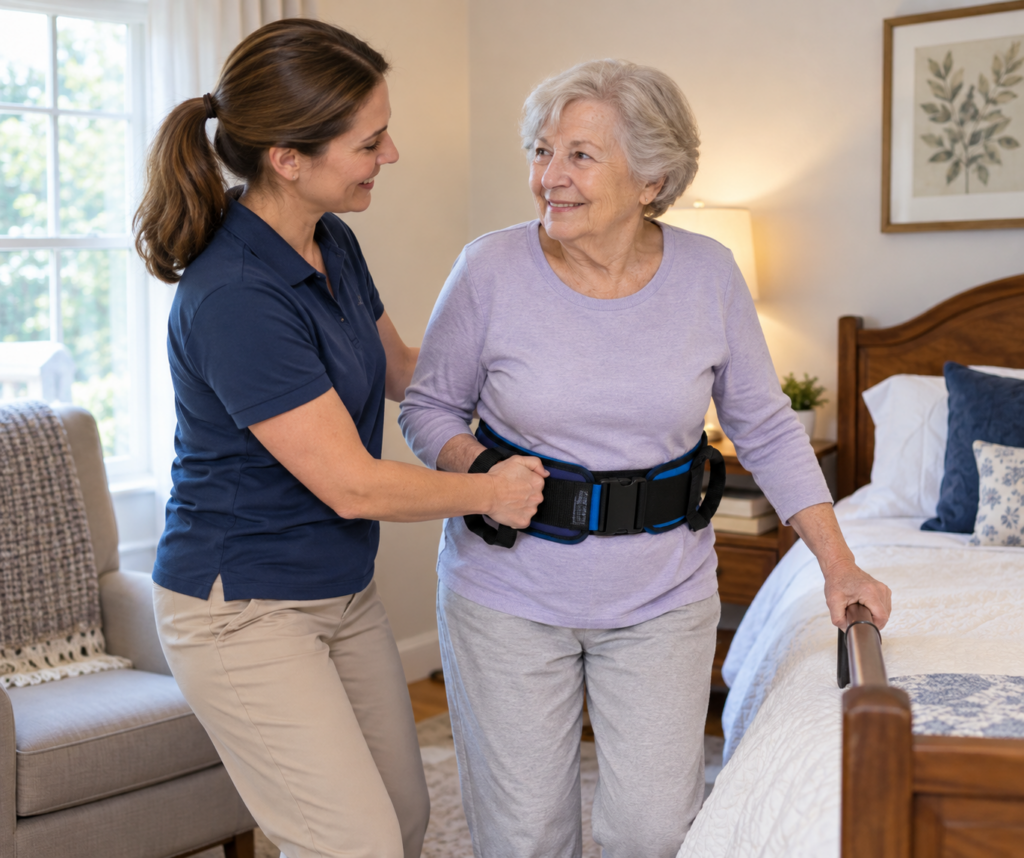
A gait belt can look surprisingly simple: a sturdy belt placed around a person’s waist so a caregiver has a more secure place to provide support. But choosing and using one safely involves much more than buying the first belt that fits.
For older adults who can still bear some of their own weight and participate in a transfer, a gait belt may provide additional support when standing, moving between surfaces, or walking with assistance. It is not, however, a substitute for a patient lift when someone cannot safely participate in the movement.
This guide explains what families should look for when comparing gait belts for seniors, including belt styles, handles, buckle designs, sizing, materials, caregiver considerations, and situations in which a different transfer aid may be more appropriate.
Quick Answer: What Should Families Look for in a Gait Belt?
When comparing gait belts for seniors, look for a belt that fits securely, is easy for the caregiver to grip, has a dependable fastening system, and is appropriate for the older adult’s physical abilities and transfer needs.
Important features can include:
- A secure buckle or fastening system
- Appropriate sizing and adjustability
- Strong, durable construction
- Comfortable material against clothing
- Multiple handles when additional gripping positions would be useful
- Easy-to-clean materials
- Clear manufacturer instructions for proper use
Just as important, families should determine whether a gait belt is actually appropriate for the person who will use it. A belt should not be treated as a way for a caregiver to manually lift someone who cannot adequately support or participate in the transfer.
What Is a Gait Belt?
A gait belt, sometimes called a transfer belt, is worn around a person’s waist or torso to give a caregiver a more secure place to provide support during certain transfers or assisted walking.
Traditional gait belts often resemble wide fabric belts with a buckle. Other models add padded sections or multiple handles that give caregivers different gripping positions.
The belt itself does not lift the person mechanically. Instead, it is one possible assistive tool for situations in which the older adult retains enough strength and mobility to participate in the movement.
Who May Benefit From a Gait Belt?
A gait belt may be appropriate for some seniors who need assistance but can still bear at least some of their own weight, follow directions, and participate in standing, transferring, or walking.
For example, a caregiver might use an appropriately selected gait belt while helping someone move from a bed to a chair or while providing support during assisted walking.
However, the person’s abilities matter more than the apparent simplicity of the transfer. Strength, balance, cognition, medical conditions, recent surgery, fall risk, and the amount of assistance required can all affect whether a gait belt is appropriate.
Families who are uncertain about the safest transfer method should consider having a physical therapist, occupational therapist, nurse, or other qualified healthcare professional evaluate the person’s needs.
A Gait Belt Is Not a Lifting Device
This is one of the most important distinctions for families to understand.
A gait belt gives a caregiver a secure place to provide appropriate support. It should not become a handle for manually lifting the full weight of an older adult.
OSHA’s guidance on gait and transfer belts describes their use for people who are partially dependent, have some weight-bearing capacity, and are cooperative, and states that the belts should not be used for lifting.
If someone cannot bear enough weight or participate sufficiently in a transfer, equipment designed for greater levels of assistance may be necessary. Our guide to patient lifts for seniors explains the major types of mechanical lifting equipment families may encounter.
Gait Belt vs. Patient Lift
Although both can be associated with transfers, gait belts and patient lifts serve very different purposes.
A gait belt depends on the older adult retaining meaningful ability to participate in the movement. The caregiver provides support and guidance while the person contributes to standing, pivoting, or walking.
A patient lift is designed for substantially greater transfer assistance and may support much or all of a person’s weight, depending on the equipment and situation.
Trying to use a gait belt where a mechanical lift is needed can put both the senior and caregiver at risk. Conversely, someone who remains relatively mobile may not require mechanical lifting equipment simply because occasional transfer assistance is needed.
Standard Gait Belts vs. Gait Belts With Handles
One of the first buying decisions is whether to choose a traditional belt or a model with dedicated handles.
Standard Gait Belts
A traditional gait belt is generally a wide strap that fastens around the person’s waist. The caregiver grips the belt itself when providing assistance.
These designs are often relatively simple, lightweight, and easy to store. Their simplicity can also make cleaning straightforward, depending on the material and buckle.
Gait Belts With Handles
Handled gait belts provide dedicated gripping points around the belt. Some include several vertical and horizontal handles so the caregiver can choose a grip appropriate to the position and movement.
Handles may make it easier to maintain a secure grip than trying to grasp the belt material itself. Padded handles can also be more comfortable for the caregiver’s hands.
More handles do not automatically make a belt safer, however. The senior’s capabilities, caregiver technique, belt fit, and appropriateness of the transfer remain more important than the number of handles.
What Type of Buckle Should You Look For?
The fastening system needs to keep the gait belt securely positioned during use while still allowing the caregiver to put it on and remove it correctly.
Common designs include metal friction buckles and quick-release plastic buckles.
Metal Buckles
Traditional metal buckles can provide a secure fastening system and allow considerable adjustment. Families should make sure they understand how the belt threads through the buckle because improper fastening can allow the belt to loosen.
Quick-Release Buckles
Plastic quick-release buckles can be convenient, particularly when a caregiver frequently puts the belt on and removes it.
Check that the buckle closes completely, remains secure under the conditions specified by the manufacturer, and is easy for the caregiver to operate without accidentally releasing it during use.
Getting the Size and Fit Right
A gait belt must fit the person for whom it is intended. A belt that is excessively loose can move out of position, while one that is too tight can be uncomfortable and inappropriate.
Do not rely only on labels such as small, medium, or large. Compare the person’s measurements with the manufacturer’s stated adjustment range.
Also consider whether the belt will normally be worn over lightweight clothing or heavier garments. There should generally be clothing between the belt and the person’s skin to reduce the chance of abrasion.
Material Matters
Gait belts are available in materials such as cotton or other woven fabrics, nylon-like synthetic materials, and padded constructions.
There is no single material that is automatically best for every senior.
Families should consider:
- Comfort
- Durability
- Ease of cleaning
- Drying time
- Grip
- Flexibility
- Manufacturer care instructions
If a gait belt will be used frequently, especially by multiple caregivers, easy cleaning can become an important practical consideration.
Using a Gait Belt During Bed-to-Chair Transfers
Moving between a bed and chair is one of the situations in which families may encounter gait belts.
The surrounding equipment matters too. Wheelchair brakes, footrests, armrests, bed height, floor conditions, and the person’s stronger and weaker sides can all affect a transfer.
If a wheelchair is part of the transfer routine, our guide to wheelchairs for seniors explains features such as removable armrests, footrests, braking systems, seat dimensions, and overall fit that families should consider.
Using a Gait Belt During Assisted Walking
Some gait belts can also provide a caregiver with a secure point of contact while assisting an older adult who is walking.
This does not mean a gait belt replaces the mobility aid a person normally needs. Someone who uses a walker, rollator, cane, or other prescribed mobility device may still need that equipment.
Our guide to walkers and rollators for seniors explains the major features families should consider when choosing walking support.
When a Gait Belt May Not Be Appropriate
A gait belt is not appropriate simply because someone needs help moving.
Extra caution is particularly important when the older adult cannot reliably bear weight, cannot cooperate with the transfer, has certain medical or surgical considerations, or requires more physical assistance than a caregiver can safely provide.
Families should also avoid assuming that adding a second caregiver automatically makes an otherwise inappropriate manual transfer safe.
If mobility has declined or transfers have become substantially more difficult, that is a reason to reassess the transfer method rather than simply pulling harder on the belt.
Using a Gait Belt Near a Toilet or Bedside Commode
Bathroom transfers can be particularly challenging because space may be limited and the person may need to turn, lower themselves, stand again, and manage clothing during the process.
A gait belt may provide an appropriate handhold for a caregiver when the older adult can participate safely in the transfer, but the rest of the environment still matters.
For someone who has difficulty reaching or using a standard toilet, a bedside commode may reduce the distance required for bathroom trips. Our guide to bedside commodes for seniors explains the major features families should consider.
Gait Belt vs. Transfer Pole
Gait belts and transfer poles can both assist with certain transfers, but they provide support in different ways.
A transfer pole is a fixed support that the older adult grips and uses to help stabilize themselves while standing, sitting, or repositioning. A gait belt is worn by the person and provides a caregiver with a more secure place to provide assistance.
Some older adults may encounter both types of equipment as part of a broader transfer plan, while others may need neither. The right approach depends on the person’s strength, balance, ability to follow directions, and level of assistance required.
Our guide to transfer poles for seniors explains when a fixed support pole may be useful around beds, chairs, and other areas of the home.
Look for Useful Handle Positions
If you are considering a gait belt with handles, look beyond the total number of handles.
Think about where the handles are positioned and whether they provide practical gripping options for the caregiver. Some designs provide horizontal handles, vertical handles, or a combination of both.
The handles should feel substantial enough to grip securely and should be firmly attached to the belt. Examine product specifications for construction details and follow the manufacturer’s instructions regarding proper gripping positions.
Padding Can Improve Comfort, but Fit Still Matters
Some gait belts include padded sections intended to improve comfort for the person wearing the belt.
Padding can be useful, particularly when the belt is used frequently, but it does not compensate for incorrect sizing or positioning.
A heavily padded belt may also be bulkier to store and may require different cleaning procedures than a simple woven belt. Families should weigh comfort against practical considerations such as cleaning, drying, storage, and ease of use.
Consider the Caregiver’s Hands and Grip
The caregiver’s physical abilities matter too.
A caregiver with arthritis, limited hand strength, or other grip difficulties may find certain handle styles or buckle mechanisms easier to use than others.
Before choosing a belt, consider whether the person who will provide most of the assistance can comfortably operate the buckle, adjust the belt, and securely grasp the intended gripping points.
No belt can make a transfer safe if the caregiver cannot physically provide the level of assistance required.
Inspect the Belt Regularly
Because a gait belt may be placed under considerable force during use, it should be inspected regularly.
Look for signs such as:
- Frayed or damaged fabric
- Loose stitching
- Damaged handles
- Cracked or distorted plastic buckles
- Bent or damaged metal hardware
- Fasteners that no longer remain secure
Stop using a belt if damage could affect its safe performance. Follow the manufacturer’s instructions for inspection, maintenance, cleaning, and replacement.
Cleaning and Infection-Control Considerations
A gait belt may come into frequent contact with clothing, hands, and occasionally bodily fluids, so cleaning requirements deserve attention.
Check whether the manufacturer permits machine washing, hand washing, wiping with disinfectant, or another cleaning method. Some belts have removable components or materials that require specific care.
If several people will use the same belt, cleaning and infection-control procedures become even more important.
Do Not Ignore the Environment Around the Transfer
A gait belt addresses only one part of a transfer. The surrounding environment can still create hazards.
Before beginning a transfer, consider whether there are loose rugs, cords, clutter, wet flooring, unstable furniture, pets, or other obstacles in the path.
Wheelchairs and other equipment should also be positioned according to their instructions and the person’s transfer plan.
The goal is not simply to complete the transfer. It is to create conditions in which both the older adult and caregiver can perform the movement as safely and predictably as possible.
Watch for Changes in the Senior’s Mobility
A transfer technique that worked several months ago may no longer be appropriate if the person’s health or mobility has changed.
Pay attention to increasing difficulty standing, repeated knee buckling, new dizziness, worsening balance, inability to follow transfer instructions, increased caregiver effort, or near-falls.
Those changes may signal that the transfer method should be reassessed rather than simply adding more force or assistance.
A physical therapist, occupational therapist, nurse, or other qualified healthcare professional can help evaluate whether the current transfer method and equipment remain appropriate.
Questions to Ask Before Buying a Gait Belt
Before purchasing a gait belt for an older adult, families may want to ask:
- Can the person bear enough of their own weight to participate in the transfer?
- Can the person understand and follow transfer instructions?
- Has a healthcare professional recommended or demonstrated the transfer method?
- What waist or torso size does the belt accommodate?
- Does the belt remain securely fastened during intended use?
- Would dedicated handles make gripping easier for the caregiver?
- Can the caregiver comfortably operate the buckle?
- How should the belt be cleaned?
- How should it be inspected for wear?
- Are there medical, surgical, skin, or other considerations that should be evaluated before use?
Gait Belt Buying Checklist for Families
When comparing gait belts for seniors, use this checklist as a starting point:
- Correct size: Confirm the manufacturer’s adjustment range against the user’s measurements.
- Secure fastening: Choose a buckle or closure the caregiver can operate correctly and confidently.
- Useful grip positions: If selecting a handled belt, make sure the handles are positioned where they can actually be used.
- Durable construction: Examine stitching, handles, straps, and hardware.
- Comfort: Consider material, width, padding, and how the belt will feel over clothing.
- Cleaning: Review the manufacturer’s care instructions before purchasing.
- Caregiver usability: Make sure the primary caregiver can grip, adjust, fasten, and release the belt.
- Appropriate level of assistance: Confirm that a gait belt matches the person’s current transfer and mobility abilities.
- Professional guidance: Seek individualized instruction when the safest transfer method is uncertain.
Frequently Asked Questions About Gait Belts for Seniors
Is a gait belt the same as a transfer belt?
The terms are often used interchangeably for belts designed to give a caregiver a secure place to provide assistance during certain transfers or mobility activities. Product designs vary, so families should evaluate the intended use and manufacturer instructions rather than relying only on the product name.
Can you lift a senior with a gait belt?
A gait belt should not be treated as a device for lifting the full weight of a person. It is intended to assist appropriate transfers or mobility activities when the person can participate sufficiently in the movement. Someone requiring substantially greater assistance may need a different transfer method or mechanical equipment.
Are gait belts with handles better?
Handles can give caregivers convenient and potentially more comfortable gripping positions, but they do not automatically make a belt appropriate for every person or transfer. Fit, construction, caregiver technique, and the older adult’s abilities remain critical.
How tight should a gait belt be?
The belt should be secured according to the manufacturer’s instructions so it does not slide or become excessively loose during use, while avoiding unnecessary constriction or discomfort. Because designs differ, follow the fitting instructions supplied with the specific belt.
Can a gait belt help prevent falls?
A gait belt may give an appropriately trained caregiver a more secure point of contact while assisting certain movements, but it does not eliminate fall risk and should not be considered a stand-alone fall-prevention solution.
Can one person use a gait belt to transfer a senior?
That depends on the older adult’s abilities, the transfer being performed, the environment, and the caregiver’s capabilities. Families should not assume that a transfer is suitable for one-person assistance simply because a gait belt is available.
Should families receive training before using a gait belt?
Proper technique matters. When a gait belt is recommended as part of someone’s care, having a qualified healthcare professional demonstrate the appropriate transfer technique can help the senior and caregiver understand how the equipment should be used.
Final Thoughts
The best gait belt for a senior is not necessarily the model with the most padding, handles, or features. It is one that fits properly, provides appropriate gripping points, can be operated reliably by the caregiver, and matches the older adult’s actual level of mobility.
Most importantly, a gait belt should be viewed as an assistive tool rather than a lifting device. If a senior’s mobility declines or a caregiver is struggling to complete transfers safely, reassessing the transfer method may be more important than purchasing a different belt.
Matching the equipment to the person’s current abilities—and getting professional guidance when necessary—can help families create a safer and more manageable transfer routine at home.
Related Articles
- Best Transfer Poles for Seniors in 2026: What Families Should Look For
- Best Patient Lifts for Seniors in 2026: What Families Should Look For
- Best Wheelchairs for Seniors in 2026: What Families Should Look For
- Best Walkers and Rollators for Seniors in 2026: What Families Should Look For
- Best Bedside Commodes for Seniors in 2026: What Families Should Look For