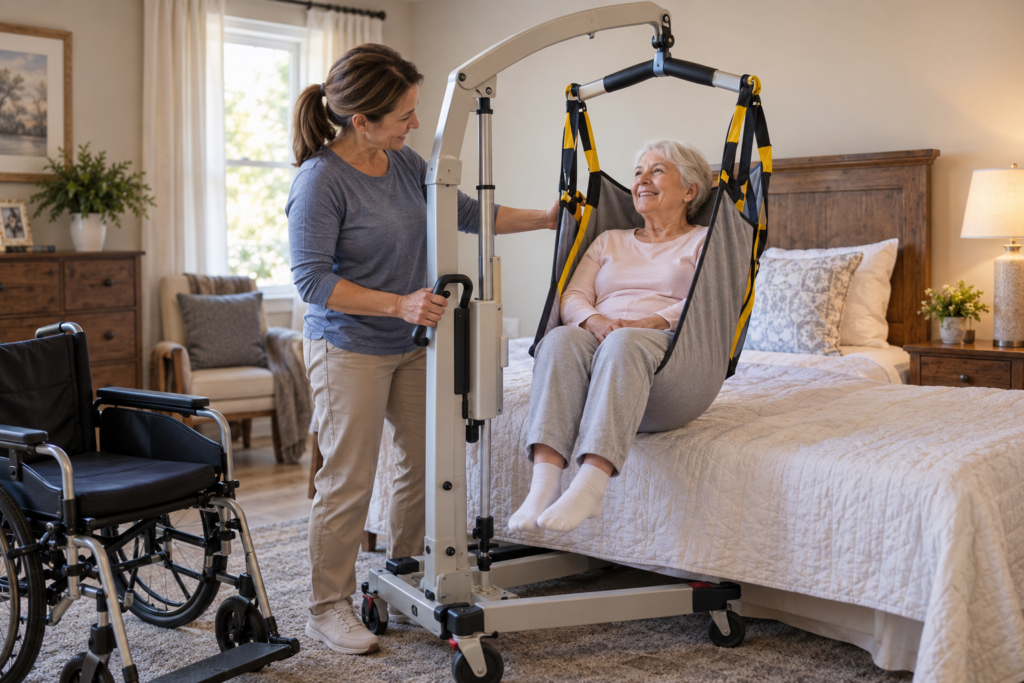
When an older adult can no longer transfer safely between a bed, wheelchair, chair, or bedside commode, a patient lift can become an important part of providing care at home.
But choosing a patient lift requires much more than finding a model with enough weight capacity.
Families need to consider how much assistance the senior requires, whether the person can bear weight through their legs, the type of transfers being performed, sling compatibility, bed and wheelchair clearance, available floor space, caregiver ability, and whether the lift will actually fit into the home’s daily care routine.
The wrong equipment can make transfers more difficult rather than easier.
This guide explains what families should look for when comparing patient lifts for seniors, including full-body lifts, sit-to-stand lifts, hydraulic and electric models, slings, weight capacity, home-space requirements, caregiver considerations, Medicare coverage, and questions to ask before buying or renting.
Quick Answer: What Should Families Look for in a Patient Lift?
When comparing patient lifts for seniors, start with these factors:
- Senior’s ability to bear weight
- Ability to sit upright and maintain balance
- Amount of caregiver assistance required
- Full-body lift versus sit-to-stand lift
- Manual hydraulic versus powered operation
- Maximum weight capacity
- Compatible sling type and size
- Lift range
- Base width and adjustability
- Clearance underneath beds and furniture
- Wheelchair and commode compatibility
- Available maneuvering space
- Flooring and threshold conditions
- Emergency lowering provisions
- Battery capacity and charging requirements
- Caregiver strength and ability
- Delivery and assembly
- Training and service
- Buying versus renting
- Potential Medicare or insurance coverage
The most important question is not which patient lift has the longest feature list. It is which transfer system is appropriate for the senior’s functional abilities and can be operated safely by the people providing care.
What Is a Patient Lift?
A patient lift is a transfer device designed to help move a person who cannot safely complete certain transfers independently.
Depending on the equipment and the senior’s needs, a lift may help with transfers involving:
- A hospital bed
- A wheelchair
- A chair
- A bedside commode
- Other compatible seating or care equipment
A patient lift does not replace a wheelchair, walker, or hospital bed. It performs a different job.
The lift assists with the transfer itself.
That distinction is especially important for families caring for someone whose mobility has declined beyond what can be managed with a cane, walker, transfer bench, or ordinary standing assistance.
Who Might Need a Patient Lift at Home?
A patient lift may be considered when an older adult requires substantial assistance transferring and manual transfers have become difficult or unsafe.
Examples may include seniors who:
- Cannot stand independently
- Cannot safely pivot between surfaces
- Have significant weakness or paralysis
- Have severe mobility limitations
- Require extensive caregiver assistance
- Are largely bed-bound
- Cannot safely transfer between a bed and wheelchair
- Need substantial assistance transferring to a bedside commode
- Have a progressive condition affecting mobility
A lift should not automatically be viewed as the next step whenever a senior has difficulty standing.
Some people may be better served by transfer training, a different wheelchair setup, a properly positioned hospital bed, a transfer aid, or another solution recommended by a qualified healthcare professional.
When transfer ability has changed significantly, a physical therapist, occupational therapist, nurse, physician, or other qualified professional can help determine what type of assistance may be appropriate.
Full-Body Patient Lifts vs. Sit-to-Stand Lifts
One of the most important distinctions is between a full-body patient lift and a sit-to-stand lift.
They are not interchangeable.
Full-Body Patient Lifts
A full-body lift supports the person in a compatible sling while the lift raises and moves them between appropriate surfaces.
This type of lift may be considered for someone who cannot safely support enough of their own weight to perform a standing transfer.
Depending on the lift and sling system, full-body lifts may be used for transfers involving beds, wheelchairs, chairs, and commodes.
The senior’s body is supported during the transfer rather than relying on the person to stand and pivot.
Sit-to-Stand Lifts
A sit-to-stand lift is intended for a different type of user.
These devices assist a person from a seated position toward standing and may support transfers between compatible surfaces.
They generally require the user to have enough functional ability to participate in the transfer.
The exact requirements vary by device, so families should not assume that someone who cannot stand independently is automatically a candidate for a sit-to-stand lift.
The senior may need sufficient leg strength, trunk control, ability to follow instructions, or other functional capabilities specified by the manufacturer or healthcare professional.
If there is uncertainty between a full-body and sit-to-stand system, obtain a professional transfer assessment before purchasing equipment.
Manual Hydraulic vs. Electric Patient Lifts
Full-body patient lifts are commonly available with manual hydraulic or powered lifting mechanisms.
Manual Hydraulic Patient Lifts
A hydraulic patient lift generally uses a caregiver-operated pump mechanism to raise the senior.
Advantages can include:
- No battery required for normal lifting
- Relatively straightforward mechanical operation
- No routine charging requirement
The tradeoff is caregiver effort.
Someone must operate the hydraulic mechanism while also managing the transfer process.
Before choosing a manual lift primarily because it costs less, consider who will use it every day and whether that person can comfortably perform the required procedure.
Electric Patient Lifts
An electric patient lift uses a powered actuator to raise and lower the senior.
This can reduce the physical effort required to operate the lifting mechanism, although it does not eliminate the need for careful caregiver involvement.
Families considering an electric model should evaluate:
- Battery capacity
- Charging procedure
- Low-battery warning
- Emergency lowering system
- Availability and cost of replacement batteries
- Service availability
Do not wait until the battery is depleted during a transfer to learn how the emergency-lowering procedure works.
The Sling Is Part of the Transfer System
The sling should never be treated as a generic accessory.
It is a critical component of the patient-lift system.
Slings can differ in:
- Size
- Shape
- Material
- Head support
- Leg support
- Opening design
- Attachment method
- Weight capacity
- Intended transfer application
A sling that physically attaches to a lift is not necessarily the correct sling for that lift or that senior.
Verify compatibility with the lift manufacturer and make sure the sling type and size are appropriate for the individual and the intended transfer.
Families should also understand exactly how the sling is positioned and attached before attempting a transfer.
Weight Capacity Is Only One Part of Proper Fit
Weight capacity is important, but it should not be the only specification used to choose a lift.
Verify the manufacturer’s stated capacity and understand what that rating applies to.
Then consider the senior’s body dimensions, sling requirements, lift geometry, transfer surfaces, and available space.
For a larger individual, a bariatric or heavy-duty patient lift may offer a higher capacity and a larger frame.
However, a larger lift may also require substantially more maneuvering space.
Measure before ordering.
Bed Clearance Can Determine Whether a Lift Will Work
A common problem occurs when the lift’s base cannot move far enough underneath the bed to position the senior correctly.
This can be especially important with beds that have:
- Low frames
- Large platforms
- Storage underneath
- Wide structural components
- Reclining or adjustable mechanisms
If the senior already uses a medical bed, compare the patient lift’s base dimensions and clearance requirements with the exact bed configuration.
Our guide to Best Hospital Beds for Seniors in 2026: What Families Should Look For explains additional considerations involving bed height, caregiver access, mattresses, rails, room layout, and transfers.
Do not assume that two pieces of medical equipment will work together simply because both are designed for home care.
Wheelchair Transfers Need Their Own Evaluation
Wheelchair transfers can present a different set of fit issues.
Consider:
- Wheelchair seat height
- Armrest configuration
- Footrests
- Wheel locks
- Seat cushion
- Available approach space
- Lift-leg clearance
- Sling placement and removal
Families evaluating the complete mobility setup can also review our Best Wheelchairs for Seniors in 2026: What Families Should Look For.
A lift that works well with one wheelchair configuration may be awkward with another, so evaluate the actual equipment the senior uses.
Bedside Commode Transfers May Also Matter
For someone who cannot safely walk to the bathroom, a bedside commode may be part of the care setup.
But placing a commode next to the bed does not solve the transfer problem if the senior cannot safely move between the two.
Families should evaluate whether the commode’s arms, seat, frame, and surrounding space work with the person’s prescribed transfer method.
Our Best Bedside Commodes for Seniors in 2026: What Families Should Look For provides additional guidance on selecting and positioning this equipment.
Does Medicare Cover Patient Lifts for Seniors?
Medicare coverage may be available for qualifying patient lifts, but families should understand the requirements before purchasing equipment independently.
CMS states that patient lifts are covered under the durable medical equipment benefit and identifies coverage for certain patient lifts used for transfers between a bed and a chair, wheelchair, or commode when the applicable coverage criteria are satisfied. Families considering Medicare coverage should review the official CMS guidance for patient lifts and work with the treating healthcare provider and Medicare-enrolled DME supplier before obtaining equipment.
Coverage should not be assumed merely because a lift would make caregiving easier.
The senior must meet the applicable medical-necessity and documentation requirements for the specific equipment.
If Medicare coverage is important, determine the required process before making a private retail purchase.
Measure the Home Before Choosing a Patient Lift
A patient lift may look relatively compact in product photographs but require considerably more maneuvering room during an actual transfer.
Families should evaluate the complete path the lift must travel rather than measuring only the place where it will be stored.
Measure and inspect:
- Bedroom dimensions
- Space beside the bed
- Clearance underneath the bed
- Doorway width
- Hallway width
- Bathroom or commode area
- Wheelchair positioning space
- Sharp turns
- Floor transitions and thresholds
- Furniture that may restrict the lift’s base
Also consider where the lift will be stored and, for powered models, where it will be charged.
A lift that technically fits through the bedroom door can still be impractical if the caregiver cannot position and maneuver it correctly around the bed.
Base Width and Leg Adjustment Matter
Many mobile patient lifts have legs that can be widened or narrowed.
This can help position the lift around certain wheelchairs, chairs, beds, or commodes.
When comparing models, check:
- Minimum external base width
- Maximum base width
- Internal clearance between the legs
- Overall base length
- Caster dimensions
- Required clearance underneath furniture
Do not assume that a wider-opening base automatically means the lift will fit around every wheelchair or chair.
The complete geometry matters.
Flooring Can Affect Maneuverability
A mobile patient lift must be positioned and moved according to the manufacturer’s instructions.
Flooring can influence how easily caregivers can maneuver the equipment.
Consider whether the transfer area includes:
- Hard flooring
- Thick carpeting
- Area rugs
- Raised thresholds
- Uneven transitions
- Damaged flooring
Do not modify the lift, substitute casters, or improvise ramps simply to overcome a flooring problem unless the manufacturer specifically permits the configuration.
If the lift is difficult for the caregiver to maneuver in the actual home environment, discuss the problem with the equipment supplier or appropriate healthcare professional.
Caregiver Ability Is Part of Choosing the Right Lift
A patient lift is designed to assist with transfers, but it does not make caregiving automatic.
The caregiver may still need to:
- Position the lift
- Position the sling
- Attach sling loops or clips correctly
- Operate the controls
- Guide the senior during the transfer
- Position the wheelchair, bed, chair, or commode
- Monitor the senior throughout the transfer
That means caregiver strength, balance, mobility, understanding, and confidence all matter.
If the person providing most of the care cannot comfortably maneuver a particular lift, a different model, different transfer method, or additional assistance may be necessary.
Training Should Happen Before the First Independent Transfer
Families should not learn to use a patient lift through trial and error while an older adult is suspended in the sling.
Before performing transfers independently, caregivers should understand:
- How to inspect the lift
- How to select and inspect the sling
- How to position the sling
- How sling attachment points work
- How to position the lift
- How to operate the lifting mechanism
- How to move the senior according to the manufacturer’s instructions
- How to lower and position the senior
- How to respond if the lift stops operating
- How the emergency-lowering system works
Ask whether the equipment supplier provides hands-on instruction at delivery.
A physical therapist, occupational therapist, nurse, or other qualified professional may also provide transfer training appropriate to the senior’s care plan.
Never Improvise Sling Attachments
The sling and lift must function as an intended system.
Do not improvise attachments using ropes, straps, belts, clips, carabiners, or other hardware that was not approved for the equipment.
Likewise, do not select a sling simply because its attachment loops appear to fit the lift.
Before use, confirm:
- Correct sling manufacturer and model when required
- Compatibility with the lift
- Correct sling size
- Appropriate sling style for the transfer
- Correct attachment configuration
- Acceptable condition of the fabric and attachment points
- Applicable weight capacity
Follow the manufacturer’s instructions for inspection, cleaning, replacement, and use.
Inspect the Lift and Sling Regularly
Patient lifts and slings are working pieces of care equipment and should be inspected according to manufacturer requirements.
Potential warning signs can include:
- Frayed or torn sling material
- Damaged loops or attachment points
- Loose or damaged components
- Unusual noises
- Difficulty raising or lowering the lift
- Battery or charging problems
- Damaged casters
- Controls that do not operate normally
- Hydraulic leakage on applicable models
If something appears damaged or does not operate as intended, stop using the equipment and follow the manufacturer’s or supplier’s service instructions.
Electric Lifts Need a Charging Routine
A powered lift is only useful if it is ready when a transfer is needed.
Families should establish a charging routine based on the manufacturer’s instructions.
Ask:
- How long does charging take?
- How is remaining battery capacity indicated?
- Can the battery be removed for charging?
- Is a second battery available?
- What happens if the battery becomes depleted during use?
- How does emergency lowering work?
Anyone who regularly operates the lift should know the answers before an emergency occurs.
Buying vs. Renting a Patient Lift
The decision to buy or rent depends partly on how long the equipment is expected to be needed.
Renting May Make Sense When:
- The senior’s need may be temporary
- The person is recovering from an illness, injury, or hospitalization
- The long-term transfer plan is uncertain
- The senior’s condition is changing
- Service and equipment replacement through a supplier are important
- Medicare or insurance requirements affect how qualifying equipment is furnished
Buying May Make Sense When:
- The equipment is expected to be needed long term
- The family is paying privately
- A specific lift and sling configuration has been professionally identified
- Long-term rental costs would substantially exceed the purchase cost
Compare the complete cost rather than the equipment price alone.
Delivery, assembly, sling costs, replacement slings, batteries, maintenance, repairs, training, and eventual pickup or disposal may affect the total expense.
Be Careful When Buying a Used Patient Lift
A used patient lift may cost less, but families should be especially cautious with equipment responsible for supporting and transferring a person.
Before considering used equipment, determine:
- Manufacturer
- Exact model
- Age
- Weight capacity
- Service history
- Whether the lift has been modified
- Condition of the frame and casters
- Condition of the hydraulic or powered lifting mechanism
- Battery condition on electric models
- Availability of replacement parts
- Availability of compatible slings
- Whether original operating instructions are available
- Whether the equipment is subject to a recall or safety notice
Do not rely on an unidentified sling that happens to come with a used lift.
Confirm the appropriate sling separately for the exact equipment and senior.
Questions to Ask a Patient Lift Supplier
Before buying or renting a lift, ask the supplier:
- What exact model are you providing?
- Is it a full-body or sit-to-stand lift?
- Is it manual hydraulic or electric?
- What is the manufacturer’s weight capacity?
- What is the lift range?
- What are the base dimensions?
- How much under-bed clearance is required?
- Which slings are approved for this lift?
- Is a sling included?
- Who determines the appropriate sling type and size?
- Will the lift work with the senior’s existing bed, wheelchair, chair, and commode?
- Is delivery included?
- Is assembly included?
- Will someone demonstrate proper operation?
- Who handles repairs?
- How quickly can service be provided?
- What happens if the equipment fails?
- What are the rental, return, and pickup terms?
- What amount will the family be responsible for paying?
Get important financial and service terms in writing.
Patient Lift Checklist for Families
Before accepting a patient lift for home use, confirm the following.
Senior’s Functional Needs
- Transfer needs have been evaluated
- Weight-bearing ability is understood
- Sitting and trunk-control abilities have been considered
- Full-body versus sit-to-stand lift has been appropriately determined
- Caregiver assistance requirements are understood
Lift and Sling
- Correct lift type selected
- Weight capacity verified
- Lift range verified
- Compatible sling identified
- Correct sling size selected
- Attachment procedure understood
- Emergency lowering procedure understood
Home Compatibility
- Bedroom measured
- Doorways and hallways measured
- Under-bed clearance checked
- Wheelchair compatibility considered
- Commode or chair compatibility considered
- Flooring and thresholds evaluated
- Adequate maneuvering space confirmed
Caregiver Readiness
- Primary caregivers have received appropriate instruction
- Caregivers can maneuver the lift
- Caregivers know how to position the sling
- Caregivers understand inspection procedures
- Electric-lift charging routine established when applicable
Purchase or Rental
- Total cost understood
- Delivery and assembly terms documented
- Included sling and accessories identified
- Repair responsibilities understood
- Rental pickup or return terms understood
- Medicare or insurance requirements investigated before private purchase
Frequently Asked Questions About Patient Lifts for Seniors
What is the best patient lift for an elderly person?
There is no single best patient lift for every older adult.
The appropriate equipment depends on the senior’s weight-bearing ability, transfer needs, physical condition, sling requirements, caregiver capabilities, room dimensions, and the surfaces involved in the transfer.
What is the difference between a patient lift and a sit-to-stand lift?
A full-body patient lift supports the person in a sling during the transfer and may be appropriate when the senior cannot safely perform a standing transfer. A sit-to-stand lift assists a person who has sufficient functional ability to participate in moving from sitting toward standing.
Follow the requirements for the specific equipment and obtain professional guidance when the senior’s abilities are uncertain.
Can one caregiver operate a patient lift?
Do not assume that every lift or every transfer can be safely performed by one caregiver.
The answer depends on the manufacturer’s instructions, the senior’s needs, the transfer being performed, the equipment, and the caregiver’s abilities. Follow the care plan and equipment instructions rather than establishing a caregiver count based on convenience.
Can a patient lift be used with a regular bed?
Possibly, but compatibility must be checked.
The lift may require sufficient clearance underneath the bed and adequate space beside it. Bed height, frame design, room dimensions, sling positioning, and the lift’s geometry can all affect whether the transfer can be performed appropriately.
Can a patient lift be used with a wheelchair?
Many patient lifts are designed for transfers involving wheelchairs, but the actual wheelchair and lift must work together.
Evaluate seat height, armrests, footrests, lift-leg clearance, sling positioning, wheel locks, and maneuvering space.
Are electric patient lifts better than hydraulic lifts?
Not necessarily.
Electric lifts reduce the effort required to operate the lifting mechanism, while hydraulic models do not require routine battery charging. The better choice depends on the senior, caregiver, frequency of use, home environment, service requirements, and budget.
Does Medicare pay for a patient lift?
Medicare may cover qualifying patient lifts under the durable medical equipment benefit when applicable medical-necessity, documentation, and supplier requirements are satisfied.
Families should establish eligibility and expected financial responsibility before independently purchasing equipment.
Can you use any sling with a patient lift?
No. Never assume slings are universally interchangeable.
Use a sling that is compatible with the specific lift and appropriate for the senior, transfer, and intended application. Follow the manufacturer’s instructions and professional recommendations.
Final Thoughts
A patient lift can be an important home-care tool when an older adult can no longer transfer safely with simpler assistance.
But selecting the right lift starts with the senior’s functional needs—not the product catalog.
Determine whether the person can bear weight, how much they can participate in a transfer, what surfaces they need to move between, and how much assistance caregivers can safely provide.
Then evaluate the complete system: lift, sling, bed, wheelchair, commode, room layout, flooring, caregiver training, charging requirements, maintenance, and payment method.
For families already using other mobility equipment, our Best Transfer Benches for Seniors in 2026: What Families Should Look For provides additional guidance for seniors who can participate more actively in bathroom transfers.
When the senior’s abilities are changing or the transfer is complicated, professional assessment and hands-on caregiver training can be more valuable than choosing equipment based on specifications alone.
The goal is not simply to lift the person.
It is to create a transfer process that appropriately supports the senior and the people providing their daily care.
Related Articles
- Best Hospital Beds for Seniors in 2026: What Families Should Look For
- Best Wheelchairs for Seniors in 2026: What Families Should Look For
- Best Bedside Commodes for Seniors in 2026: What Families Should Look For
- Best Transfer Benches for Seniors in 2026: What Families Should Look For
- Best Walkers and Rollators for Seniors in 2026: What Families Should Look For