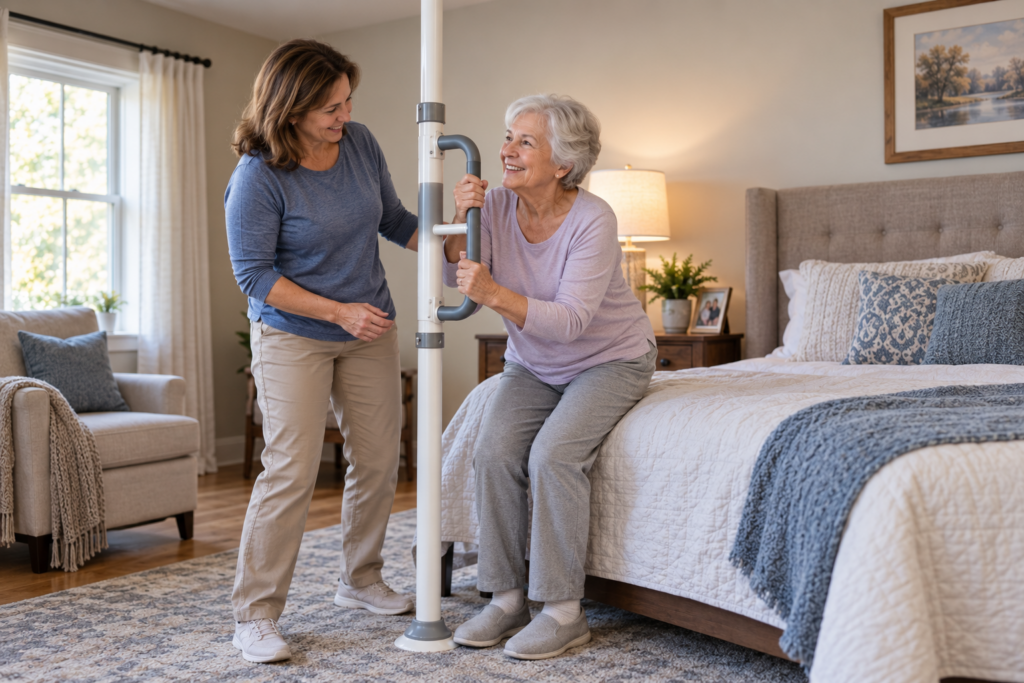
For an older adult who can still stand and participate in a transfer but needs something secure to hold onto, a transfer pole can provide additional support beside a bed, chair, or other frequently used location.
Transfer poles are sometimes called security poles, support poles, floor-to-ceiling grab bars, or standing-assist poles. Unlike a traditional wall-mounted grab bar, many transfer poles use a vertical design that can place a handhold where the senior actually needs it.
But a transfer pole is not appropriate for everyone.
The senior must have enough strength, balance, coordination, and weight-bearing ability to use the device as intended. Someone who requires substantial physical assistance or cannot safely support their own weight may need a different transfer solution.
This guide explains what families should look for when comparing transfer poles for seniors, including floor-to-ceiling designs, fixed and pivoting handles, weight capacity, installation requirements, ceiling and floor compatibility, placement, grip design, bathroom and bedside use, and situations in which a transfer pole may not provide enough assistance.
Quick Answer: What Should Families Look for in a Transfer Pole?
When comparing transfer poles for seniors, consider:
- The senior’s ability to stand and bear weight
- Where the pole will be used
- Floor-to-ceiling versus permanently mounted installation
- Ceiling height requirements
- Ceiling construction and compatibility
- Floor surface and stability
- Manufacturer-rated weight capacity
- Fixed versus pivoting support handles
- Handle height and adjustability
- Grip size and texture
- Space around the bed, chair, or toilet
- Whether the pole creates an obstruction or trip hazard
- Installation requirements
- Whether professional installation is appropriate
- How the device will be inspected for continued stability
Most importantly, make sure the senior’s functional abilities match the type of assistance the pole is designed to provide.
What Is a Transfer Pole?
A transfer pole is a vertical support device that provides a handhold for someone moving between sitting and standing or repositioning during certain transfers.
Depending on its design and intended use, a transfer pole may be positioned near:
- A bed
- A favorite chair
- A recliner
- A toilet
- Another location where the senior regularly needs standing support
Some models use tension or another manufacturer-specified mounting system between the floor and ceiling. Others may require permanent attachment.
Certain models include a horizontal or curved handle that remains stationary, while others provide a handle that can rotate or lock into different positions.
These differences can significantly affect how the device works in a particular room.
Who May Benefit From a Transfer Pole?
A transfer pole is generally intended for someone who can actively participate in standing or transferring.
That may include an older adult who:
- Can bear weight through their legs
- Can pull or push themselves toward standing
- Needs a stable handhold when rising
- Has difficulty finding a convenient support point near the bed or chair
- Needs additional stability while turning or repositioning
- Can understand how and when to use the device
OSHA’s safe-patient-handling guidance distinguishes stand-assist devices from equipment used for people who are partial- or non-weight-bearing. Its nursing-home guidance describes stand-assist devices as appropriate for people who are weight-bearing, cooperative, and able to pull themselves from sitting toward standing.
That distinction is useful at home as well: a transfer pole provides support, but it does not lift the senior.
When Is a Transfer Pole Not Enough?
A transfer pole should not be used as a substitute for a higher level of transfer assistance when the senior cannot safely participate in the movement.
Warning signs that a different approach may be necessary include:
- The senior cannot reliably bear weight
- The knees frequently buckle
- The person cannot maintain sitting or standing balance
- The senior cannot grip or use the pole reliably
- A caregiver must physically lift most of the person’s weight
- The senior’s mobility varies substantially from one transfer to another
- The person has recently experienced a significant decline in transfer ability
In these situations, families should obtain an appropriate transfer assessment rather than attempting to compensate by adding more handholds.
For seniors who require substantial assistance, our guide to Best Patient Lifts for Seniors in 2026: What Families Should Look For explains full-body lifts, sit-to-stand lifts, slings, caregiver requirements, and home-space considerations.
Transfer Pole vs. Bed Rail
Transfer poles and bed rails can sometimes appear to serve similar purposes, but they are different types of equipment.
A bed rail attaches to or works with the bed and may provide a handhold for repositioning, getting into or out of bed, or other manufacturer-specified uses.
A transfer pole is typically a vertical structure positioned near the transfer area and is not necessarily attached to the bed.
A pole may offer more flexibility in where the handhold is positioned, particularly when the bed itself does not provide a useful gripping point.
Families considering bedside support should also review our Best Bed Rails for Seniors in 2026: What Families Should Look For because the appropriate solution depends on the senior, the bed, the room, and the type of assistance required.
Floor-to-Ceiling Transfer Poles
Floor-to-ceiling models are among the most common transfer-pole designs for home use.
These poles extend vertically from the floor toward the ceiling and use the manufacturer’s specified installation system to create a stable support structure.
One potential advantage is placement flexibility.
Rather than being limited to the location of a wall stud, a compatible floor-to-ceiling pole may be positioned closer to the place where the senior needs a handhold.
However, installation requirements vary considerably.
Before buying one, verify:
- Permitted ceiling-height range
- Compatible ceiling construction
- Compatible floor surfaces
- Whether structural attachment is required
- Whether the product can be used with sloped or vaulted ceilings
- Required clearance around the pole
- Manufacturer installation instructions
Never assume that a tension-mounted pole can be installed safely against every ceiling simply because it reaches the correct height.
Ceiling Construction Matters
The ceiling is part of the support system for many floor-to-ceiling transfer poles.
That makes ceiling compatibility a major purchasing consideration.
Homes may have:
- Standard flat ceilings
- Suspended or drop ceilings
- Sloped ceilings
- Vaulted ceilings
- Decorative ceiling treatments
- Other construction that affects installation
Follow the manufacturer’s requirements for the exact model rather than assuming that an installation method used for another transfer pole will also be acceptable.
If there is uncertainty about the ceiling structure or mounting surface, professional installation may be appropriate.
Floor Surface Matters Too
The bottom of the transfer pole must also interact correctly with the floor.
Check whether the manufacturer permits installation on the flooring in the intended room.
Examples may include:
- Hardwood
- Tile
- Vinyl
- Laminate
- Carpet
Do not place boards, pads, blocks, shims, or other improvised materials beneath a transfer pole unless the manufacturer specifically allows that installation method.
A support device is only useful when it remains stable during actual use.
Fixed Handles vs. Pivoting Handles
Transfer poles can provide very different gripping arrangements.
Fixed Handles
A fixed handle stays in one position.
This can provide a predictable gripping location each time the senior stands or sits.
For someone who follows essentially the same movement during every transfer, simplicity may be an advantage.
Pivoting Handles
Some transfer poles have handles that rotate and lock into multiple positions.
This may allow the senior to reach for support from different angles during a transfer.
For example, the handle may be positioned toward the bed while the senior begins standing and then repositioned according to the product’s design as the transfer continues.
When evaluating a pivoting design, consider:
- How the handle locks
- Number of locking positions
- Whether the senior can operate it independently
- Whether a caregiver must reposition it
- Whether it could swing into a walkway
- Whether its movement could interfere with nearby furniture
The most adjustable design is not automatically the safest or easiest choice.
Weight Capacity Must Match the Intended User
Always verify the manufacturer’s rated weight capacity for the exact transfer pole and handle configuration.
Do not assume that similar-looking poles have similar ratings.
Also remember that weight capacity alone does not determine whether the device is appropriate.
The senior must be able to use the pole in the manner for which it was designed.
A high-capacity pole does not convert a standing-assist device into a lifting device.
Handle Height and Grip Design
The senior should be able to reach and use the handhold without excessive stretching, twisting, or leaning.
Consider:
- Handle height
- Handle diameter
- Grip texture
- Number of gripping positions
- Senior’s hand strength
- Arthritis or other hand limitations
- Senior’s height
- Position from which the person begins the transfer
A handle that looks comfortable in a photograph may be poorly positioned for a particular person once installed beside the actual bed or chair.
Placement Beside a Bed
Bedside placement is one of the most common reasons families consider a transfer pole.
The goal is to place the support where the senior can reach it during the actual sequence of sitting up, moving toward the edge of the bed, standing, and turning as appropriate.
Placement should account for:
- Which side of the bed the senior uses
- Mattress height
- Bed-frame dimensions
- Senior’s sitting position
- Where the feet contact the floor
- Nearby furniture
- Walking path after standing
- Caregiver access
If the senior uses specialized bedding or an adjustable sleep system, our guide to Best Adjustable Beds for Seniors in 2026: What Families Should Look For explains additional considerations involving bed height, positioning, mobility, and bedroom setup.
Transfer Poles Should Match the Senior’s Actual Abilities
The decision to use a transfer pole should begin with the person rather than the product.
OSHA’s guidance on stand-assist equipment emphasizes assessing the individual’s weight-bearing ability and ability to participate in the transfer. It also advises checking that a stand-assist device is stable and appropriately rated for the person using it. OSHA’s guidance on resident lifting and transfer equipment provides additional information about matching assistive equipment to functional ability.
Although OSHA’s guidance is written for nursing-home workplaces rather than as a consumer buying guide, the underlying distinction is useful for families: different levels of mobility require different forms of transfer assistance.
If an older adult’s ability to stand, balance, grip, or follow the transfer sequence has changed, consider having the transfer method reassessed before purchasing equipment.
Using a Transfer Pole Near a Chair or Recliner
A transfer pole may also provide a useful handhold beside a frequently used chair or recliner.
Before choosing this setup, observe how the senior actually gets up from the chair.
Consider:
- Seat height
- Seat depth
- Armrest position
- Senior’s ability to move forward in the seat
- Where the senior naturally reaches while standing
- Where the feet are positioned
- Whether the chair moves during the transfer
- Walking path after standing
Recliners deserve additional attention because their position and dimensions change as the chair moves.
Make sure the transfer pole and handle cannot interfere with the chair’s reclining mechanism, footrest, electrical components, or normal movement.
For seniors who need powered assistance rising from a chair, a transfer pole may not address the primary problem. Our guide to Best Lift Chairs for Seniors in 2026: What Families Should Look For explains how lift chairs assist with the transition between sitting and standing.
Using a Transfer Pole Near a Toilet
The bathroom is another location where families may consider a transfer pole, particularly when there is no conveniently positioned wall for a traditional support bar.
Bathroom placement requires careful planning.
Consider:
- Distance from the toilet
- Senior’s ability to reach the handle
- Available floor space
- Door swing
- Sink or vanity location
- Shower or tub access
- Whether the pole obstructs a caregiver
- Whether the floor and ceiling are compatible with the specific product
Also consider whether another type of support would better address the problem.
A raised toilet seat can reduce the distance a person must lower and raise themselves, while a toilet safety frame can provide bilateral hand support. A transfer pole provides a different form of assistance.
The best solution depends on the senior’s abilities and bathroom configuration rather than simply adding as many support devices as possible.
Transfer Pole vs. Grab Bar
A traditional grab bar and a transfer pole both provide a handhold, but they differ significantly in installation and positioning.
Grab Bars
Grab bars are commonly installed on a wall or other manufacturer-approved structural surface.
They can be particularly useful in bathrooms where a properly positioned wall is available.
Transfer Poles
A transfer pole provides vertical support and may offer more placement flexibility in a room when an appropriate wall-mounted handhold cannot be positioned where the senior needs it.
Some transfer poles also provide multiple gripping positions or pivoting handles.
Neither design is automatically better.
Choose based on the location, installation requirements, senior’s movement pattern, and type of support required.
Do Not Use Furniture as a Substitute for a Proper Support Device
Some older adults instinctively reach for nightstands, dressers, towel bars, movable chairs, or other nearby objects when standing.
That can be risky because ordinary household items may move, tip, detach, or fail when used as transfer supports.
If a senior repeatedly reaches for furniture while standing or transferring, treat that behavior as useful information.
It may indicate that the person needs a properly positioned support device or that the transfer method should be reassessed.
Watch for Trip and Collision Hazards
A transfer pole should improve the transfer area without creating a new obstacle.
Before installation, consider the entire walking path around it.
Ask whether the pole or handle could interfere with:
- A walker or rollator
- A wheelchair
- A caregiver
- A bedroom doorway
- A bathroom doorway
- A bedside table
- A recliner
- A wheelchair footrest
- Other frequently used furniture
Pivoting handles deserve particular attention because their footprint can change depending on their position.
Installation Is a Safety Issue
A transfer pole must be installed exactly as required by the manufacturer.
Installation requirements can differ by product, so do not assume that instructions from one pole apply to another.
Before installation:
- Confirm ceiling-height compatibility
- Confirm floor compatibility
- Confirm ceiling compatibility
- Read the complete manufacturer’s instructions
- Identify required tools
- Determine whether permanent attachment is required
- Verify required clearances
- Check that the chosen location supports the intended transfer
If the home’s construction is uncertain or the installation instructions require structural attachment beyond the family’s comfort level, consider professional installation.
Check the Pole After Installation
Installation is not the final step.
Before relying on the pole for everyday transfers, follow the manufacturer’s procedures for confirming that the equipment is secure and correctly installed.
Continue inspecting it according to the manufacturer’s instructions.
Things that may warrant attention include:
- Movement at the floor or ceiling
- Loose fasteners
- A handle that does not lock correctly
- Unexpected rotation
- Visible damage
- Changes in flooring or ceiling surfaces
- Unusual noises
If the pole no longer feels or operates as intended, stop relying on it until the problem has been addressed.
Consider the Senior’s Hands and Upper-Body Strength
A transfer pole requires active participation.
That means families should consider more than leg strength.
A senior may have difficulty using a pole because of:
- Arthritis
- Weak grip
- Limited shoulder movement
- Arm weakness
- Pain when pulling
- Poor coordination
- Difficulty reaching the handle
If the senior cannot maintain a reliable grip or safely use the upper body during the transfer, simply installing a larger handle may not solve the problem.
Think About Changes in Mobility Over Time
A transfer pole that works well today may not remain appropriate if the senior’s mobility changes.
Families should periodically reconsider the transfer setup if they notice:
- More difficulty standing
- Increasing caregiver assistance
- Repeated loss of balance
- Difficulty gripping the pole
- Knee buckling
- New pain during transfers
- Confusion about how to use the device
- A fall or near-fall during a transfer
A change in function may mean the senior needs a different support device or a new professional assessment.
Questions to Ask Before Buying a Transfer Pole
Before purchasing a transfer pole, ask:
- What is the manufacturer’s weight capacity?
- What ceiling heights are supported?
- Which ceiling types are permitted?
- Which flooring surfaces are permitted?
- Does installation require drilling or permanent attachment?
- Can the pole be relocated?
- Is the handle fixed or pivoting?
- If it pivots, how does it lock?
- Is the handle height adjustable?
- How much floor space does the base require?
- How often should installation tension or fasteners be checked?
- Are replacement parts available?
- What warranty is provided?
- Is professional installation available?
Compare these answers with the senior’s actual transfer needs and the exact room where the pole will be installed.
Transfer Pole Buying Checklist for Families
Senior’s Abilities
- Can bear weight sufficiently for the intended transfer
- Can participate actively in standing
- Can maintain an appropriate grip
- Can reach the proposed handle position
- Can understand how to use the support
Home Compatibility
- Ceiling height measured
- Ceiling construction identified
- Floor surface checked
- Installation location measured
- Doorways and walking paths considered
- Nearby furniture evaluated
- Caregiver access preserved
Product Specifications
- Weight capacity verified
- Installation requirements reviewed
- Handle design evaluated
- Grip position appropriate
- Pivoting mechanism evaluated if applicable
- Required maintenance understood
- Warranty and replacement-part availability checked
Installation and Ongoing Use
- Manufacturer instructions available
- Installation completed as specified
- Stability checked before use
- Senior understands how to use the pole
- Caregiver understands its intended purpose
- Routine inspection plan established
Frequently Asked Questions About Transfer Poles for Seniors
Are transfer poles safe for seniors?
A transfer pole can provide useful support when the equipment is appropriate for the senior, compatible with the home, installed according to the manufacturer’s instructions, and used as intended.
It should not be treated as a lifting device or used to compensate for a level of mobility loss that requires greater assistance.
Can a transfer pole help a senior get out of bed?
It may help some seniors who can sit, bear weight, grip the support, and actively participate in standing.
Whether it is appropriate depends on the person’s abilities, bed configuration, pole placement, and transfer method.
Is a transfer pole the same as a grab bar?
No. A transfer pole is typically a vertical support structure positioned between the floor and ceiling or otherwise installed according to its design. A grab bar is generally mounted to a wall or another approved structural surface.
Both provide hand support, but their installation and positioning differ.
Can a transfer pole be used beside a toilet?
Some transfer poles may be suitable for use near a toilet when the manufacturer permits the installation and the room provides appropriate floor, ceiling, and positioning conditions.
The senior’s needs should also be compared with other bathroom supports such as grab bars, toilet safety frames, and raised toilet seats.
Can a transfer pole be installed on carpet?
That depends on the specific product.
Do not assume that every floor-to-ceiling transfer pole can be installed over carpeting. Follow the manufacturer’s requirements for permitted flooring and installation surfaces.
Can a transfer pole be installed with a vaulted ceiling?
Many floor-to-ceiling designs require particular ceiling conditions and may not be suitable for sloped or vaulted ceilings.
Check the manufacturer’s instructions for the exact model before purchasing.
What is the difference between a transfer pole and a patient lift?
A transfer pole provides a handhold for someone who can actively participate in standing or transferring. A patient lift supports or lifts a person who requires substantially more assistance.
They address different levels of mobility and should not be considered interchangeable.
How much weight can a transfer pole support?
Weight capacities vary by manufacturer and model.
Always verify the rating for the exact product rather than relying on a general capacity for transfer poles.
Final Thoughts
A transfer pole can be a practical aging-in-place tool for an older adult who remains capable of participating in standing and transfers but needs a secure, conveniently positioned handhold.
The best choice depends on much more than price or weight capacity.
Consider the senior’s strength, balance, grip, transfer technique, bed or chair configuration, floor and ceiling construction, handle design, installation requirements, and the surrounding walking path.
Most importantly, recognize when the senior’s needs have progressed beyond what a transfer pole can appropriately provide.
A transfer pole is a support device, not a patient lift.
Matching the equipment to the senior’s actual abilities—and reassessing that match as mobility changes—is more important than choosing the model with the longest list of features.
Related Articles
- Best Patient Lifts for Seniors in 2026: What Families Should Look For
- Best Bed Rails for Seniors in 2026: What Families Should Look For
- Best Lift Chairs for Seniors in 2026: What Families Should Look For
- Best Raised Toilet Seats for Seniors in 2026: What Families Should Look For
- Best Toilet Safety Frames for Seniors in 2026: What Families Should Look For